Sorry for not updating this blog for a long ass time. The new semester started few months ago and I have been intense for a long time.
No, actually, I had no enough time to write anything on my blog for months. The last time I updated my blog was last month when I tried to write a post about meeting with Missouri Senate candidate Jason Kander, who is also the Secretary of State of Missouri.
I think I could only post once a month rather than every week to adjust my school schedule and my habit of being lazy.
Then again, I won't update this frequently and I am still following money in politics news. Maybe someday, I could interview someone famous who happens to be a Facebook friend of mine.
I apologize about this delay and I will see you next time.
Yes. I know. It is too late to post a blog about the 50th anniversary of the Voting Right Act. But I am gonna do it anyway.
Before I go into this, I will announce that I will be returning to U.S. next week. Just to prepare for the sophomore year this month there won't be second blog.
Anyway, it's been a half of century since LBJ passed the Voting Rights Act, which prevent discrimination in voting and bring equality to the ballot box for all Americans, regardless of the color of one's skin. However, in 2013, the Supreme Court struck down the Section 4 of the law, the formula laying out which jurisdictions had to seek federal approval for election law changes, which makes the Section 5 of the law - giving minorities to vote - inoperable.
A 5-4 majority looked at improvements in black voter registration rates and the eradication of restrictions like the poll tax to find that the "conditions that originally justified [Section 5] no longer characterize voting in the covered jurisdictions."
In her dissent, Justice Ruth Bader Ginsburg decried that the majority was holding the Act's own success against it. "Throwing out preclearance when it has worked and is continuing to work to stop discriminatory changes," she responded, "is like throwing away your umbrella in a rainstorm because you are not getting wet."
At its heart, the disagreement boils down to whether, as a nation, we still need federal protections against the possibility of racial discrimination in voting. Although we have come a long way since the 1960s, the past few years have shown that major racial divisions still exist. They may even have gotten worse since 2013, as large majorities of white and black Americans now view race relations as "generally bad," according to a recent poll.
The recent rash of discriminatory voting laws, unleashed by the Shelby County decision, does not help. States have used the court's implicit approval as justification to pass strict measures. These may not be as obviously discriminatory as literacy tests, but they similarly prevent people from voting.
For example, mere hours after the high court ruling, Texas implemented a strict photo ID law, which had previously been rejected under Section 5. That summer, the North Carolina legislature passed a sweeping law that also instituted a stringent photo ID requirement, eliminated same-day registration, and cut back on early voting.
All of these laws respond to phantom complaints of voter fraud, and all disproportionately hurt the ability of minorities to vote. In October 2014, a federal judge found 600,000 registered Texas voters do not have acceptable ID. Testimony showed African-American and Hispanic registered voters are two to four times more likely than white registered voters to lack photo ID. In North Carolina, data showed African Americans used early voting and same-day registration at much higher rates than whites.
This seems like one of those "racism is over" rationale. Part of this excuse to get rid of racial equality of this country.
Ari Berman, a journalist who have been covering voting rights throughout his career, the Supreme Court's 2013 Shelby county decision made the Voting Rights Act more vulnerable. In his op-ed for New York Times, the voter IDs laws after the decision made the voting more restrictive and thousands of voters turned away from it. A 2014 study by the Government Accountability Office found that voter ID laws in Kansas and Tennessee reduced turnout by 2 to 3 percent during the 2012 election, enough to swing a close vote, with the highest drop-off among young, black and newly registered voters.
That's one of the reasons why there was a low turnout during the 2014 mid-term - voting restriction laws prevented minority voters and younger voters, these same progressive-minded people who voted for Barack Obama in 2008 election. The Republican Party - the party that supports the voter ID laws - wants to make the electorate older, whiter and more conservative as opposed to how the electorate was in 2008.
On the bright side, there has been some efforts to bring back the voting rights to all the people. Couple of months ago, Oregon passed the law that to automatically sign up eligible citizens in the motor vehicle database. Also, several states have advanced bipartisan reforms to modernize voter registration in recent years, and have expanded early voting opportunities and moved registration online.
Right now, the Congress has introduced two separate bills — the Voting Rights Amendment Act and the Voting Rights Advancement Act — that would restore the lost protections of Section 5, making it operative once again, and modernize the Voting Rights Act for the 21st century. On this historic anniversary for our country, Congress should move swiftly to restore the lost promise of the Voting Rights Act.
The Voting Rights Act exist not for the racial equality, but for advancing the core of democracy.
This needs to be a major concern for everyone - no matter how they viewed the 2013 decision. This could be a major concern for 2016 election, especially for Ari Breman:
I think in many ways we've come to take the VRA and what it did for granted, but the fact that states can pass new voting restrictions, those states with the worst histories of voting discrimination, no longer have to clear their election changes with the federal government means that: No. 1, those states can pass new restrictions very close to the election that are very hard to challenge, and ... No. 2, that other states are going to feel emboldened to try to pass these efforts.
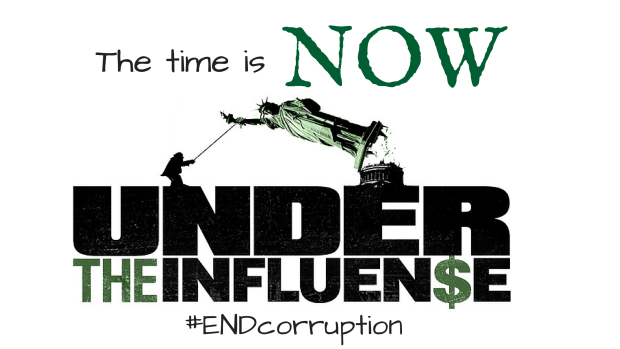
It was a morning in Seoul, South Korea. I looked at my iPhone and the notification says that the hashtag '#EndCorruption' is trending on Twitter. It led me a series of tweets which links to the Indiegogo campaign page for fundraising the documentary Under The Influence.
The conception of documentary begins with a filmmaker named Terry Bennett and his son, Sy, who had a cancer and 9 months to live, following Doris “Granny D” Haddock, an old woman who protested against corporate money in politics by walking from California to Washington D.C.. Granny D made herself a big news by walking 10 miles a day for 14 months back in 1999, during the time John McCain and then-Senator Russ Feingold was planning to propose a campaign finance regulation. She became interested in campaign finance reform and raised an awareness by becoming a real-life Forrest Gump. She have had enough with corporate influence in political process so much. and said "We’re losing our democracy, and nothing’s being done about it.”
Granny D even ran for a Senate seat in 2004, at the age of 94. She lost but still remain active in politics until her death in 2010, and pass the torch to all of us.
After his son's death, Terry Bennett met Sam Oliver and the two realized they had a mutual passion for the subject and took to the road, following the same footsteps Granny D took. They interviewed many people and activists, including Cenk Uygur of Wolf-PAC and Ben Cohen of Stamp Stampede. They finished with interviews, but they had little money to edit footage together. The filmmakers asked the people of Indiegogo page to fund-raise a money for the editing in order to complete it.
There has been many documentaries recently about corporate influence in politics like Citizen Koch and Pay 2 Play. These movies might prove that 2010s will be the decade when the people fight back at the rigorous establishment formed by corny capitalism. Starting at the wealthiest country in world, the United States of America.
You know things are not right when a former majority leader and Republican Senator from Kansas thinks we should stop this money in politics. He said he is troubled by the amount of money that is being spent on political campaign. Dole, the GOP's presidential nominee in 1996, said in a recent interview for AARP Bulletin that campaign spending gone out of hand.
What has been the biggest change in presidential politics since you were the Republican nominee in 1996?
Money. Now they talk about raising $1 billion to run for president. It's unreal. We need to do something to stop all this money inpolitics. I've always believed when people give big money, they — maybe silently — expect something in return.
Do you think you could have been the nominee if money had played such an important role back then?
I don't think so. And I might not be conservative enough to be the nominee today.
Whether you agree with his politics or not, he is right about the current state of the presidential campaign. Not only that, he also concerns about the recent polarization within the congress and how his Republican Party is no longer the party that he used to know as we can see this editorial written by The New York Times staffs:
“It seems to be almost unreal that we can’t get together on a budget or legislation,” said Mr. Dole, the former Senate majority leader and presidential candidate. “I mean, we weren’t perfect by a long shot, but at least we got our work done.”
The current Congress can’t even do that, thanks to a furiously oppositional Republican Party, and that’s what has left mainstream conservatives like Mr. Dole and Senator John McCain shaking their heads in disgust.
Senators Marco Rubio and John McCain last month, two Republicans at odds over how to deal with the federal debt.Approach to Debt Widens Rift Among G.O.P. SenatorsMAY 24, 2013
The difference between the current crop of Tea Party lawmakers and Mr. Dole’s generation is not simply one of ideology. While the Tea Partiers are undoubtedly more extreme, Mr. Dole spent years pushing big tax cuts, railing at regulations and blocking international treaties. His party actively courted the religious right in the 1980s and relied on racial innuendo to win elections. But when the time came to actually govern, Republicans used to set aside their grandstanding, recognize that a two-party system requires compromise and make deals to keep the government working on the people’s behalf.
The current generation refuses to do that. Its members want to dismantle government, using whatever crowbar happens to be handy, and they don’t particularly care what traditions of mutual respect get smashed at the same time. “I’m not all that interested in the way things have always been done around here,” Senator Marco Rubio of Florida told The Times last week.
Tom Mann of the Brooking Institute and Norm Ornstein of the American Enterprise Institute released a book in the spring of 2012 called: "“It’s Even Worse Than It Looks: How the American Constitutional System Collided With the New Politics of Extremism". In an essay taken from the book, the duo wrote:
We have been studying Washington politics and Congress for more than 40 years, and never have we seen them this dysfunctional. In our past writings, we have criticized both parties when we believed it was warranted. Today, however, we have no choice but to acknowledge that the core of the problem lies with the Republican Party.
The GOP has become an insurgent outlier in American politics. It is ideologically extreme; scornful of compromise;unmoved by conventional understanding of facts, evidence and science; and dismissive of the legitimacy of its political opposition.
When one party moves this far from the mainstream, it makes it nearly impossible for the political system to deal
(You could read more further on how polarization got so heavy in Washington in this article here)
All of them have this connections between big donors' demands in Washington and their endorsed candidates from both parties. Republican Presidential candidate Lindsay Graham sponsored a bill that will ban internet gambling in the Senate when his big supporter and donor, Sheldon Adelson, a billionaire casino owner, asked him to do so in order to get rid of competitors. Big donors like Alice Walton of Walmart and big Israel supporter Haim Saban from Democratic side, in other hand, already got Hillary Clinton in their pocket and push her to have policies that could benefit them not only financially, but also their personal interest like agreeing with her political opponents' Israeli policies.
This is one big disconnect between their voters and candidates. They spent most of the time through raising campaign money form their big donors and only meet their voters through the candidate's donor-sponsored small speeches, rather than talk with them face to face. That's what Bernie Sanders did with his supporters: gathering up ten thousand people in Madison, Wisconsin last week - maybe the biggest in 2016 election.
Big money in politics is one of biggest issues we must talk about during 2016 elections. Candidates from both parties have discussed about reforming the government and some of them, including Republicans, willingly support campaign finance reform.
This is not a partisan issue - but BIPARTISAN issue. We must act now. We must return to the time Bob Dole used to familiar with.
In this article that's surfacing around the net about the recent polls among voters show that there are too much influence from wealthy individuals within the elections and, of course, money in politics.
American voters say their top concerns about the upcoming presidential election are wealthy individuals and corporations who might have too much influence who over wins, as well as campaigns that spend more time on negative attacks than proposing solutions, according to a new NBC News/Wall Street Journal poll.
Also, most of these issues the voters concern about were election issues. Most people concerns about what's behind the curtain rather than the candidates.
Thirty-three percent of voters say the influence of wealthy individuals and corporations is their top concern, while 25 percent say they're more worried about negative attacks.
Another 16 percent are more concerned that nothing will change no matter who wins, and 12 percent believe that too many wealthy candidates don't understand the economic problems of average Americans.
But only 4 percent of voters say their top concern are dynastic candidates — like Jeb Bush, Hillary Clinton and Rand Paul — who are from families who have run for the presidency before.
I have seen more people grew interests in joining the campaign finance reform and its causes. Whether its Wolf-PAC or Ben Cohen's Stamp Stampede movement, people demands more voices in the government rather than the megaphone-level of voices from corporations.
Yesterday, Vermont Senator Bernie Sanders, a self-described democratic socialist, kicked off his Presidential campaign against former Secretary of State Hillary Rodham Clinton, who announced her candidacy since April 12th.
Speaking from Burlington, Vermont, where Sanders served as mayor from 1981 to 1989, he declared a revolution for the middle class family and laid out his progressive agenda. "Today we stand here and say loudly and clearly: Enough is enough. This great nation and its government belong to all of the people and not to a handful of billionaires."
You could go to his campaign website right now and see what happened in Burlington.
Actually before photos and videos from his campaign launch released in online, the website gotten 404 error and Sanders posted up this video of himself explaining the error message.
It is interesting to see more people begin to prefer Bernie Sanders over Hillary Clinton, who is too conservative for mainstream liberals and progressives' taste and tries way too hard to pander left-wing bases.
In fact, she has a lot of campaign money from big businesses and corporate banks like Goldman Sachs. Believe it or not, her family's charitable Clinton foundation faces so much scrutiny for accepting donation from foreign countries and oil companies.
Bernie Sanders made his public image as some sort of an antithesis of President Barrack Obama's 2012 Republican opponent Mitt Romney. Or just an opposite of President Obama himself. People, especially liberals and supporters of Occupy Wall Street movement, wanted Massachusetts Senator Elizabeth Warren to ran for the President of the United States. However she declined the challenge, so her supporters decided to endorse Sanders as an alternative to Warren.
The problem is: can Sanders make it?
First, I like his campaign model. He accepts public donation rather than Super PAC money as many candidates usually accepts. His Presidential goal is to overturn Citizens United and restore democracy back to the people. Second, throughout his political career, he is honest. Even one of conservative politicians in Washington will admits that Sanders is one of the most honest politicians in the house. And finally, he openly declared war on billionaires and oligarchs and constantly spread his populist message. He will expand medicare and improve healthcare system, give larger tax to the rich, and make college tuition free.
However, here are possible problems along the way as a long shot candidate.
Billionaire donors like the Koch brothers would public smear him through negative ads produced by their own Super PACs and bring down his campaign. Good thing is, this won't deters Sanders, and he said he will not do attack ads and decided to play fair. Also, he is open about his socialist view and considering how United States of America had a negative attitude toward Marxian idealism and left-wing views in the past (look up McCarthyism), people won't easily accept his message. But that doesn't worries Sanders. He even replied to George Stephanopoulos's concerns about upcoming Republican attack ads that Sanders will turn America to Scandinavia, by saying, "What is wrong with Scandinavian countries?" (By the way, socialism is now popular among millennials.)
Most importantly: the cost. Any candidates with public-financed campaign and supported by the Occupy Wall Street movement will never make it due to the cost of being in televised debate. According to former Governor of Louisiana Buddy Roemer, who tried to ran as Republican in the last Presidential election, the broadcasting network won't invite him to the televised debates between other Republican candidates because he didn't have enough money. When Roemer ran for Louisiana governor, he had seven televised debates. He liked being in debate because he liked the "fire and the passion." That was when he had a million and half dollars and won the election while others have more money than him. The problem for him now, if he wants himself to be in people's living room television, he have to raise more money and be on the debate. He had both Washington and state political experience, but he never invited to national debate.
If Bernie Sanders could make himself to the televised debate, then he better pile up all money he could. Fortunately his campaign able to raise more than 1.5 million dollar in less than 24 hours, more than any other current Republican candidates in the first 24 hours after their announcement. 4 days later, his campaign raised 3 million - a building anticipation.
Ben & Jerry Ice Cream founders Ben Cohen and Jerry Greenfield jumped into his support as well along with actors Mark Ruffalo from The Avengers and Patton Oswalt. While other people in Washington and in Hollywood publicly endorse Hillary Clinton, Sanders managed to bring ragtag group of idealists on his side.
For me, I would personally endorse him. In fact, he is one of my favorite politicians in Washington. If I live in the most chaotic moment in the history of mankind and lists out three people I could forever trust with, one of them would be Bernie Sanders (the others are Paul Krugman and Glenn Greenwald).
Even before his campaign launch, I flirted with democratic socialism and admired Nordic model of democracy. Scandinavian countries like Norway or Sweden tends to have less political corruption and all political campaigns are public financed. Also, they don't have income inequality and anyone can live like their ideal capitalist while the state provide appropriate amount of welfare at the same time. If their way democracy proven to be efficient, why can't United States of America learned anything from them?
How many times do we have to listen political ads from candidates how pro-family they are or how much moral they have. I am tired of this "one guy with big megaphone on a soap box" way of election. It is time for people to get up and vote for candidate who can represent their voters, not billionaire donors.